If you like the weight savings of quilts, but prefer the draft free cold weather performance of sleeping bags the false bottom design might be for you. A full sleeping bag wraps a full cocoon of insulation around the user that fully closes to keep heat in and airflow out. However, any insulation placed underneath a sleeper is rendered mostly ineffectual when it is compressed by our body weight and we already have the appropriate insulation there in the form of a sleeping pad. So why carry it around? This is why quilts are so popular these days. We just get rid of it. However, quilts can have some drawbacks. Being open on the bottom gets rid of the weight of the bottom insulation that is mostly unused, but means that when a sleeper moves little bits of cold air can sometimes sneak in as the sides lift up or move around. This doesn't always matter if the temperature isn't arctic cold and there are ways to mitigate it. Straps can secure the sides down fairly well and building it a little wider can help make sure the edges remain draped over the sides. The false bottom picks up the best of both worlds. It is essentially a very narrow quilt connected on the bottom with a 12" width of ultralight fabric, turning it into a full sleeping bag. The single layer of ultralight fabric weighs almost nothing, meaning the finish weight is equivalent to an impractically narrow quilt, with draft free performance of a sleeping bag with a generous inner girth. I use a single strap to attach the bag to your sleeping pad and keep you on it with the false bottom down. The use of this strap is optional. It is fully removable. The sides of the false bottom can also be pulled together by removing the strap and clipping the sides together, turning it into a narrow sleeping bag with full wrap down insulation.
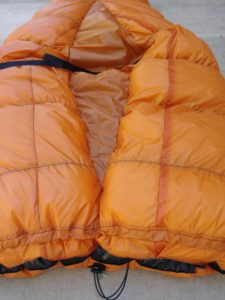
The snap top false bottom of a Serpentes reduces the overall weight of the system by 9 - 12% over an equivalent size without a false bottom, depending on the dimensions and fill quantity. A Wren style false bottom typically reduces the overall weight by 8 - 10% over an equivalent size without a false bottom, depending on dimensions and fill quantity.
For most people, keeping the false bottom down against the pad is very easy. For this reason, most do not use the pad strap. As with all sleep systems, a user should turn inside of the system, instead of rolling with the system. Rolling the system with you is rather inefficient and compromising since you compress and shift the fill while moving instead of allowing it maintain coverage and loft while you turn inside. Additionally, spinning inside keeps you on the pad, rather than tending to roll off it. When a sleeper lifts themselves up to turn over inside a system, they inevitably press down and anchor the false bottom in place so it doesn't spin. Typically, the only conscious adjustment that needs to be made in the night is realigning the top end with the torso. Since the neck is usually cinched, there is some friction here. The false bottom will stay in place, due to body weight, but the top might want to spin slightly to the direction of the turn. This is pretty easy to manage. It really can't twist too far, given that the torso area is anchored in place, and adjusting it back is super easy.
That said, false bottom systems without a pad strap may not be ideal for folks who really toss and turn while totally unconscious. Keeping the bottom in place is very, very easy if the user is even partially conscious, but if someone is completely unconscious and flailing, it might not be the right choice. For this person, the pad strap is likely warranted, or the added weight of a system with bottom side insulation might be a good trade off. Most of our systems can be built with full wrap chambers that extend to the bottom, in lieu of a false bottom, as a custom order. That is almost always massive overkill though. If someone is worried about accidentally exposing some of the false bottom, it's appropriate to use the lightly insulated version of the false bottom, as seen on the Winter Wren. Typically, the maximum function of bottom insulation is to fill in little 1" or smaller gaps. The parts that are fully compressed have no insulation value at all. So it doesn't really make much sense to have 4" of loft on the bottom when the biggest gap your insulating is a 1" gap between your pad and your low back....or a little space along the edge, or whatever. The one exception would be the person that is likely to spin the whole false bottom up. That person might have to accept the weight and efficiency trade off and have full wrap, high loft.
We've had numerous feedback reports of single layer false bottom systems being successful down to -10f with no ill effect of the false bottom feeling cold. I've personally had one down to -15f several times, with no ill effects. Below this point, we simply don't have any data since the low loft FB is always recommended as a precaution. That said, no limitation has been found yet, in terms of lower limits.