Using the total weight of down in an item is a highly inaccurate method for assessing warmth. At one point in time, when items were more dimensionally uniform, it may have been a decent ballpark assessment. However, in modern times, it’s really a wild shot in the dark, even if the consumer is diligent about matching the sizes and features of the items. This has been explained with text in many places, but lately I’ve been trying to put visuals onto some of the text.
Why is total fill weight so inaccurate? Simply because we don’t know how much volume that amount of fill is being spread into. Two items could have the same amount of total fill, but they could be spreading that fill into much different volumes. Spreading a set amount into less volume results in more quantity and loft per area. Here is a visual on that.
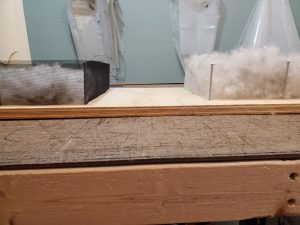

Here I created two 1/4 size models of market examples. These are the flattened profiles of the examples, as if you were to open up a quilt and lay it out flat. I filled each with the same amount of total fill. 14 grams of 900fp down. The right model is a mid-size Serpentes (50/58/38/38 x 72). The left model is a general sizing profile that many quilts around use. The dimensions match many advertised regular / regular sized quilts with a 54″ shoulder width and a 40″ foot circumference. These two items are regularly compared as “like items” which folks would compare using total fill weight.
We can see that when we spread the 14 grams of fill into the volume of the Serpentes, the down is lofted almost above the edges of the container, up to at least 3.5, while the 14 grams in the left model is down low, around 2.5″. That 14 grams in the Serpentes is going to be worlds warmer than the 14 grams spread thin in the quilt. This isn’t necessarily meant to highlight one as better than the other, but rather to highlight how far off total fill weight usually is. A consumer would see similar dimensions and equal total fill weights and assume these are the same level of insulation when they actually are considerably different.
In a market example, the consumer might see a Serpentes 20 with 11oz fill weight and a 20f quilt with 14oz fill weight and assume that the quilt must be warmer. In reality, the Serpentes, with the 11oz fill weight has more fill quantity and loft per area and more insulation at any point. For a quilt of those dimensions to achieve the same R-value as the Serpentes, it would need 16oz of total fill weight.
This is just one example, but the same extreme variability exists with different types of down items. Comparisons with mummy bags, quilts, and garments especially. With all the different tapers and dimensions within garments, the total volume is all over the place. As more and more innovation and variability is introduced into down gear, total fill weight becomes more and more irrelevant as a metric.