My go-to right now is a Timmermade Thrush false bottom bag. The false bottom bag is really the way to go for me. I tend to run fairly cold, especially when inactive. I have to build a quilt wide in order to limit the drafts that come in when I toss and turn, whereas a false bottom I can use a much narrower and lighter insulated area and still end up with a roomy and warmer interior with no drafts. I like to curl up in fetal position to conserve warmth and the FB bag allows me to take up the wide space without the edges pulling up. I never have any issue venting in warmer weather, mostly just through the top, but if it’s really warm, I just get out of the bag and drape it over me as needed. My personal Thrush is the same design as the normal one, only it’s built in a trimmed down size, which allowed me to build a 30f bag that I can reasonably take down to 20f that only weighs 14oz.
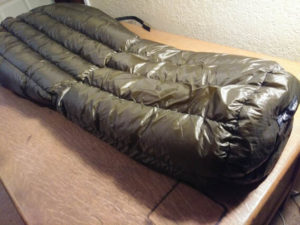
The top of the bag is cut smaller than normal. My shoulders are about 42″ in circumference and the top of this bag is cut at 45″. Basically just enough room to get in. When I built it, I thought that I could have gone tighter, and technically I could, but this feels tighter to get in than I thought it would.
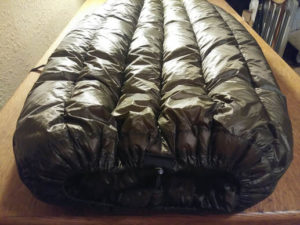
The torso area quickly widens up to 64″ in circumference. This is large enough for me to bring both knees up into fetal position, which is a position I use to conserve warmth. When you lay out straight, your limbs act as big radiators with lots of surface area exposed to the air where it is lost. When you curl up in a ball your body is exposing much less surface area to the air and instead places it against other parts of your body so the warmth stays within. Pretty much every living thing on our planet uses this strategy and it’s in our own evolutionary history. When we humans get cold we instinctively curl up. I know we live in climate control and have gotten used to sleeping sprawled out, but it is a bit funny that we often don’t use the basic, natural method for staying warm in cold weather when we are out in cold weather. Having a bag sized large enough to accommodate this position is essential to me. If I don’t actually sleep through the night like that, I at least need it to warm up when I first get in, or if I get cold at some point in the morning. I also sometimes use this large area to lay or sit cross legged, mostly before going to sleep. I often have cold feet. I can function through the day just fine, even if they are really cold, but I simply cannot fall asleep while they are in “cold mode”. To remedy that I lay for a while with a jacket on and my legs crossed in the torso part of the bag with each foot tucked into the opposite leg. This is like a super heater for my feet and once I get them “jump started” they stay nice and warm through the night in the sleeping bag.
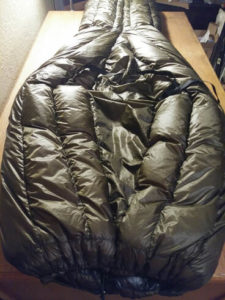
From that wide torso, the bag narrows down, like a normal Thrush, to a straight footbox from the knee down, only I built it smaller on my bag. I took this down to 35″ for the bottom third of the bag, instead of the usual 38″ or 40″. I came up with this number by taking my foot length and figuring out what the smallest circle it could fit into would be. I thought 35″ was going to be the very minimum and feel pretty tight. It actually feels quite roomy and I’m sure I could have gone down to at least 32″. Maybe less.
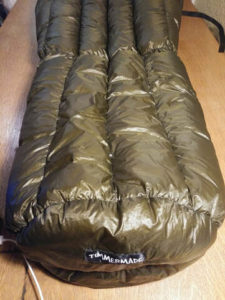
It has a sewn footbox, as it’s lighter than the drawcord footbox. While it can be nice to open up the footbox and walk around wearing your sleep system, I decided in favor of lighter weight on this one. The false bottom has the usual removable pad strap, which I don’t use very often, but typically bring with me in case I want to. Sometimes I’m on an uneven surface or whatever and just want the bag strapped down to the pad to keep things in place. It has the usual dense 1600% overstuffed chambers with 950 fill power DWR down and the same large differential cut as the normal Thrush so that I can’t accidentally compress the fill when pressing against the shell. This is a very important feature, in general, but especially when using sleeping positions like fetal that take up a wide girth and often press against the shell. With the large diff cut, the load from my pressing against the bag is taken up by the inner shell and all the down remains fully lofted. In fact, I often use the inner shell tension to hold myself in fetal position.
As always, I use a Waterbear balaclava with this bag. These days it’s a Climashield SUL Waterbear. It’s only 1.5 ounces with the full breathing tube. I choose this one because, being Climashield, it works well as part of the sleep system but also works great during the day. Climashield holds it’s loft in wet/moist/sweaty conditions so I don’t have to worry about exposing down fill to the elements that I’m depending on for my sleep system.
I’ve been using quilts for quite a while and like the freedom of movement, but, I’m always reaching around behind me to tuck it in when I toss and turn. Haven’t found a strap system that solves this, although the Katabatic pad attachments work pretty well. I also like to splay my knees when sleeping on my back, and no mummy bag ever accomdated this. The widest qults let me do so. I’m intrigued by your false bottom / fetal bags. It seems like these would accomodate all my sleep positions without the drafts and bother of straps or tucking myself in. Is there any way to to get approximate weight specs on your various quilts?
Gonna throw in a comment/question for you about rainwear here too (feel free to move it to where it is appropriate). I agree with all your reasoning about the shortcoming of wpb and why impermeable rainwear makes sense. I personally like the Columbia outdry shells simply because they do not wet out, at all. They also seem to breathe a bit. Still, I’d like to experiment with dcf rainwear. Have you ever considered building a poncho/cagoule that has room for a backpack under it? I’ve always wanted to be able to ditch the pack liner and also not have my pack wet out. I think most any pack gains a lot of weight in the rain. All those nylon straps are sponges. Wanna make me a dcf cagoule with a pack pocket on the pack? Extra credit if it is long enough to reach below m knees, then I could ditch the rain pants too.
That false bottom design was born out of dissatisfaction with quilt strap systems. They just don’t really do a decent job for anyone who moves around at all. Edge tension systems do a slightly better job of limiting drafts, but create lengthwise tension on a system, which is not good for loft. False Bottom has zero drafts and allows size customization to get the fit you need for your movement. The Draft Skirt Quilt (Coati) is also an improvement on the quilt draft issues. Also allows edge tension out on the edge of the skirt where it doesn’t put tension on the body of the system.
Between all the different systems and all the selectable options, there are hundreds of variations. The specs for each variation is shown on the product page when you select it.
We currently have both a silpoly and DCF version of the MegaZip poncho available.