



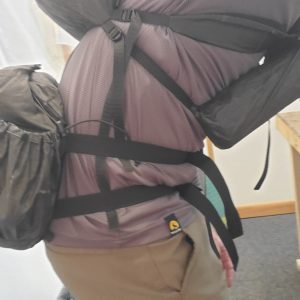
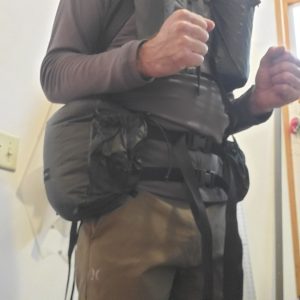

Our hips can carry weight very well, as any weight placed here transfers directly onto sleletal structures and our largest muscles, unlike our shoulders, which transfer weight directly onto smaller muscles and soft tissues that sag under the weight. Our shoulders are a really convenient place to hang things because we have such a horizontal ledge there. However, out trapezius muscles and spinal structure aren’t really used to carrying lots of weight and often need some conditioning. Our hips, on the other hand, are used to carrying the full weight of our torso and body. Traditionally, backpacks take some of the load off our shoulders and place it onto our hips through a frame that connect to a hip belt and lifts the shoulder straps off our shoulders. The hip belt, shoulder straps, and load lifters can be adjusted to distribute the load between hips and shoulder as needed. This is a good system, but there are some modern fastpacking habits that ask for another possibility for weight distribution.
First, if a pack is lifting the weight up off your shoulders, it’s often not able to secure against the weight bouncing when you run. So you could design a good running pack that locks the entire load down well, but then you have your entire load on your shoulders, not being lifted at all by any frame. This is mostly fine for very UL loads, but it’s still nice to be able to remove some shoulder weight, even at very low base weights, as sometimes you’re still carrying for a long resupply or water carry.
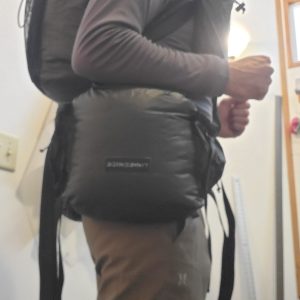
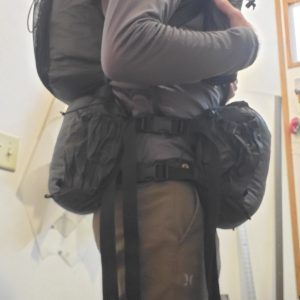
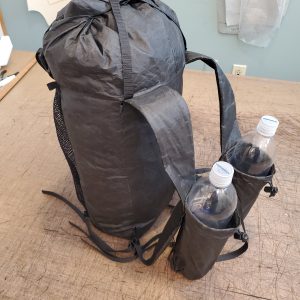
There are advantages to distributing weight by physically separating bags. Obviously, compared to carrying the same load in one running pack, you’re taking weight off your shoulders and putting it onto your hips, where it carries well. Compared to a framed pack, you secure the load much better for running, but still distribute weight. Additionally, you gain a lot of mobility. By connecting your hips, back, and shoulders through a frame, they end up a little locked together. This can be fine for pure hiking, but when you’re getting into running and scrambling, they can be restrictive. If you have a light pack on your back and a light pack on your hip, these two can move independently, while distributing load. By separating into two bags, each of them becomes much more accessible, on-the-fly. A hip pack can be spun around and its entire contents accessed while walking. If all food weight has been moved to the hip pack and the backpack is only carrying base weight, it’s really easy to swing around and open while walking. You also add modularity. These hip packs are interchangeable. You can use one 10L, two 10L front/back, two 10L side-to-side, one 20L, and a 10L with a 20L front/back.
The biggest trick with hip packs is combating the cantilever effect. We’re mounting to a vertically narrow point, but placing weight hanging off it. These tend to want to tilt away from your body, which puts a lot of tension into the hip belt. These hip packs split the belt into two straps that are separated so that the vertical weight is held by the lower strap and the upper strap holds it from tilting. These can be moved around to change this dynamic as needed.
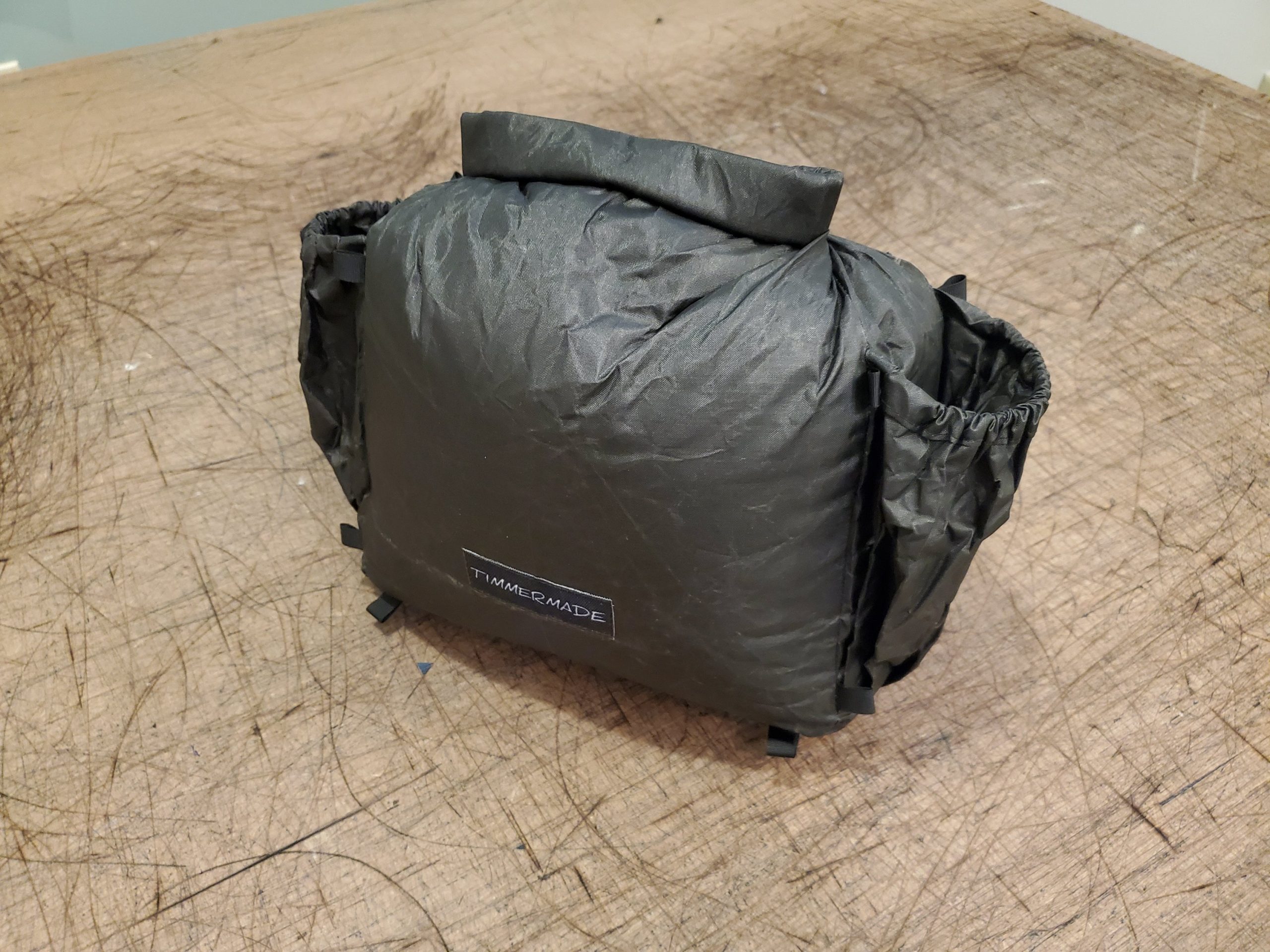
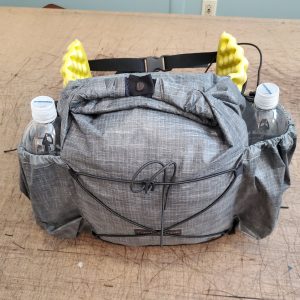
These packs have a large rolltop main compartment that is approximately 10.5 x 3.5 x 15 with two rolls and two large side pockets that are 7″ tall and have a 13″ circumference. There are 12 tabs along seams which can be used to run shockcord on four sides if you want extra spots to hang and stuff things.
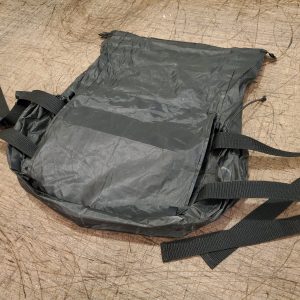
There is a sleeve on the backside that is about 9″ tall and 10″ wide, which can be used for inserting various padding. It can be used with no foam, you can cut one to exact size, or you can slide a foam pad into it. It is not wide enough for two widths of Zlite pad, but it can take a 6 panel section, folded to one width. This width fits nicely between the hip straps and protrudes out the side. More than 6 panels seems like it will start to push the pack out too far and this amount might be too thick for some peoeple.
Approximately 10 liters. 10.5 x 3.5 x 15, plus two large side pockets. Approximately 5oz per pack in Technoforce Steel.
Reviews
There are no reviews yet.